
Entomology Collection Guide
How to Choose Entomology Collection Storage
Cornell drawers, Riker mount cases, unit trays and insect collection boxes serve different purposes. This guide explains how to match each format to the way a collection is stored, studied, displayed and expanded.
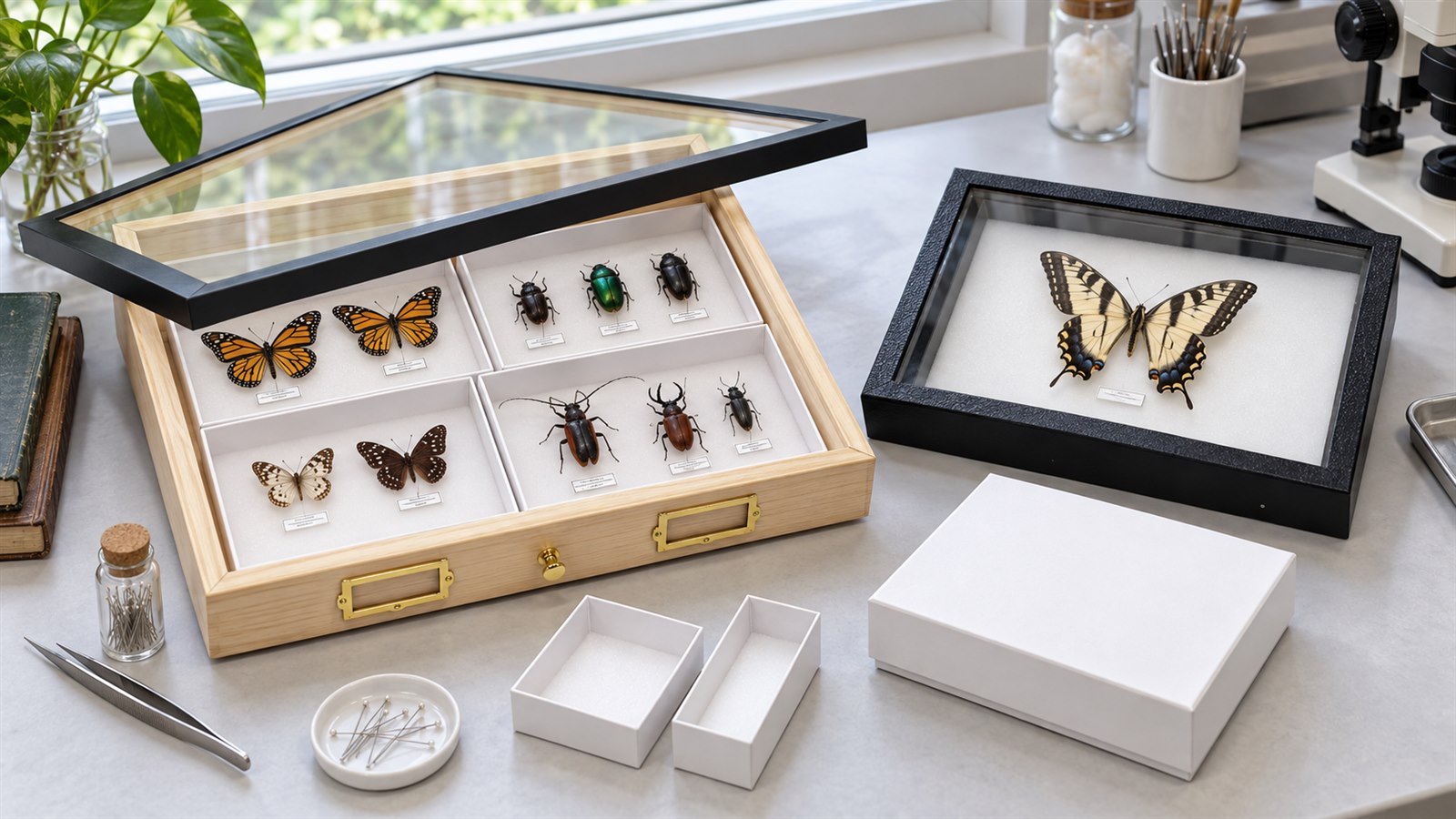
Choosing an entomology storage system is not simply a matter of selecting a box that fits the specimens. A useful system must also support identification, safe handling, efficient use of cabinet space and future collection growth. The best choice depends on the size and type of the specimens, how often they will be examined, whether they need to be displayed, and how the collection will be catalogued.
Four commonly used formats are Cornell drawers, Riker mount cases, entomology unit trays and insect collection boxes. They can be used separately, but they are often most effective when combined as parts of a larger collection-management system.
1. Cornell Drawers for Systematic Collections
Cornell drawers are designed for organized collections that need repeat access. Their broad internal area can accommodate pinned insects, labels and removable unit trays, while a glass top allows the contents to be inspected before the drawer is opened.
This format is especially suitable for museums, universities and research collections where specimens are grouped by taxonomic order, family, genus, geographic origin or project. Drawer-based organization also makes it easier to reorganize a collection as new material is added.
Choose a Cornell drawer when:
the collection contains many pinned specimens;
researchers need regular access to labels and specimens;
the drawer must work with an existing cabinet;
unit trays will be used to create smaller organized groups.
2. Riker Mount Cases for Display and Presentation
Riker mount cases are compact glass-top display cases. They work well for individual butterflies, beetles and small specimen arrangements that are intended for teaching, exhibitions, retail presentation or private collections.
Unlike a large research drawer, a Riker case presents a limited group of specimens as one visual composition. The available internal depth should be checked against the specimen height, label arrangement and selected liner before ordering.
Choose a Riker mount case when:
display is more important than high-density storage;
one specimen or a small group will be presented together;
the case will be used for a classroom, exhibition or private display;
a compact and self-contained format is preferred.
3. Unit Trays for Flexible Drawer Organization
Entomology unit trays divide a large drawer into smaller removable sections. This makes it possible to move or rearrange a specimen group without disturbing the rest of the drawer.
Tray dimensions should be planned as a coordinated system. A mixture of compatible sizes can help fill the drawer efficiently while leaving space for different specimen groups. Liner type and thickness should be selected according to the pins and specimens that will be used.
Choose unit trays when:
a collection is frequently reorganized;
specimens need to be grouped within a larger drawer;
staff need to remove a small section for study or imaging;
consistent labels and modular layouts are required.
4. Insect Collection Boxes for Teaching and Project Sets
Insect collection boxes provide a practical option for teaching sets, field-project material, student collections and smaller reference groups. They can be easier to transport and allocate than a full cabinet-and-drawer system.
When portability matters, confirm how the lid closes, how the liner is secured and how the packed specimens will be protected during handling. A collection box intended for routine transport may require a different specification from a box used only on a shelf.
Key Questions Before Ordering
What are the outside and usable inside dimensions?
Must the drawer fit an existing cabinet or standard?
What specimen and pin heights must the interior accommodate?
Which liner material and thickness are required?
Will unit trays be used, and in what size combination?
How often will specimens be accessed or transported?
Are custom labels, colors, hardware or packing required?
Build a Coordinated Storage System
A large institutional collection may use Cornell drawers inside storage cabinets, unit trays inside each drawer, collection boxes for teaching or project material, and Riker mount cases for selected public displays. Planning these formats together helps create consistent dimensions, labels and workflows.
Before requesting a quotation, prepare the required format, dimensions, quantity, intended specimen type, preferred liner and cabinet compatibility. If a standard is being matched, a drawing or physical sample can help confirm the details.
Need Help Selecting a Collection Storage Format?
Send YiYang your required dimensions, quantity and intended application for a tailored product recommendation and quotation.
Request a Quote